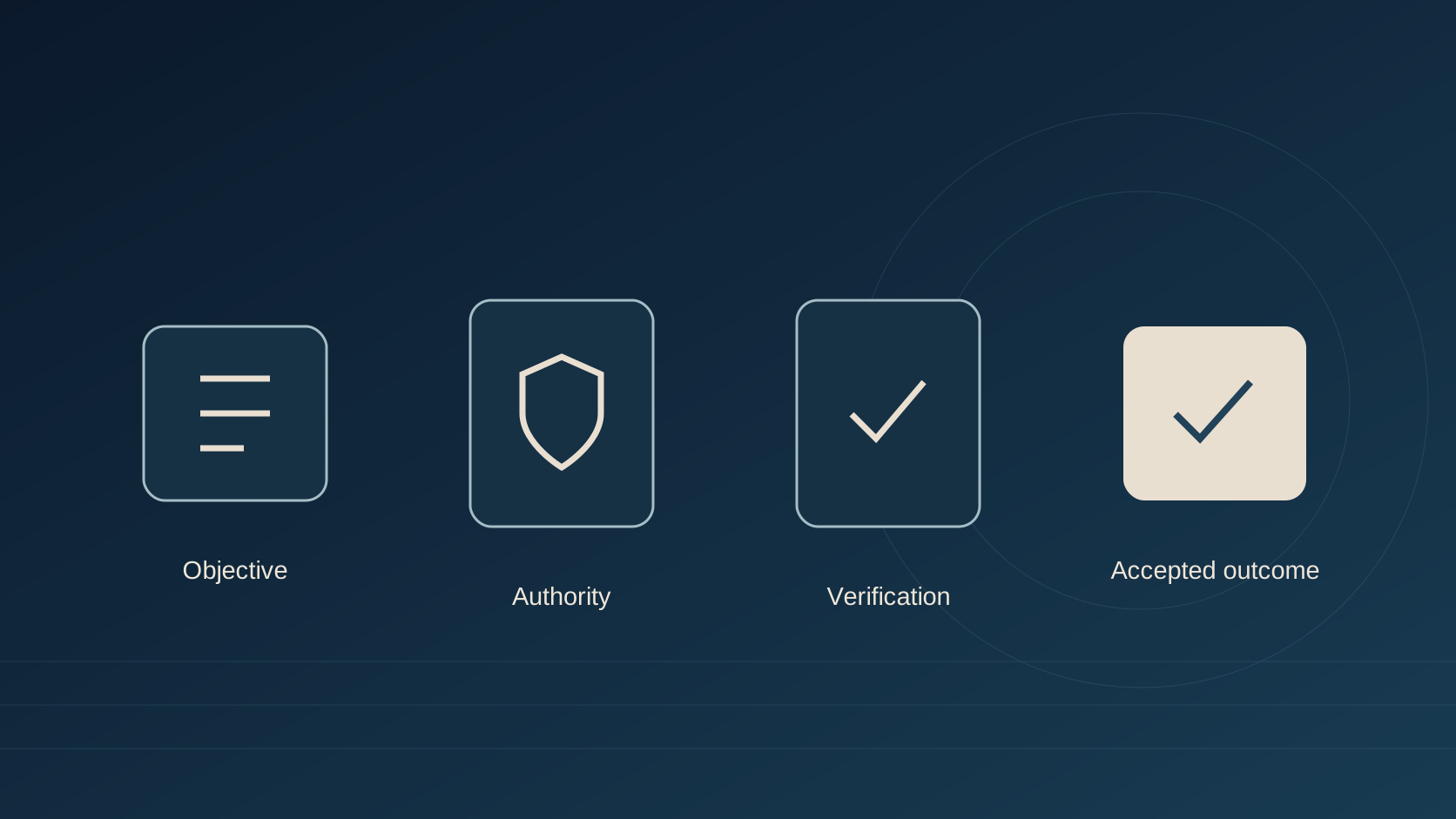
An agent that can finish work changes the investment decision. The question moves beyond the quality of an answer to the reliability of a process: can an organization delegate a useful outcome, control the actions taken, and recover when execution goes wrong?
Google’s Gemini at Work announcement makes that question timely. The opportunity deserves attention, but the strongest implementation will begin with a business constraint and a clear boundary for delegation.
What changed
On October 8, 2026, Google introduced the Gemini agent as a connected interface for completing work across enterprise systems. Its announcement describes persistent execution, reusable skills, coordination between agents, and model selection. It also describes agent identity, permissions, audit trails, sandboxing, and spending controls. [1]
These are Google’s announced capabilities. This article does not independently validate their effectiveness or assume every feature is available in every region, edition, or integration. Before committing, confirm the availability and contractual scope of the specific workflow with the provider.
Find value in the handoffs
My interpretation is that the most useful opportunity lies where work repeatedly crosses organizational boundaries. Consider a customer escalation: a team gathers evidence, checks the account context, identifies the responsible owner, prepares a response, and tracks the resolution. Delays often come from waiting for those handoffs rather than writing the final message.
An agent may reduce that coordination effort. But a faster draft only creates value if the next step also happens correctly. A response waiting in a queue, or a recommendation that requires complete reconstruction, has shifted the work rather than removed it.
Start with one measurable constraint: time to an approved response, unresolved cases, or the effort required to prepare a verified report. Establish the current baseline before introducing automation. Track completion quality alongside speed, including cases that require escalation or correction.
Time recovered becomes a financial benefit only when it changes capacity, service quality, avoidable cost, or another business result. It should not automatically be counted as a cash saving.
Define authority before autonomy
Delegating an objective is not the same as delegating every action required to achieve it. The workflow needs a named business owner and an explicit agreement about what the agent can do.
For an illustrative customer escalation workflow, that agreement might be:
- Read: Retrieve permitted case records and approved account information.
- Prepare: Draft an internal recommendation with links to the supporting evidence.
- Request approval: Submit the proposed customer response to the responsible person.
- Act after approval: Send that specific response through an authorized integration.
- Escalate: Stop when records conflict, required evidence is missing, or the requested action exceeds its authority.
The owner remains accountable for the process and its acceptance criteria. Approval should attach to a specific proposed action, destination, and content; a broad approval at the start is a weak substitute when the agent later encounters new information.
Credentials and tool permissions must enforce this agreement. Prompt instructions alone should not be the boundary preventing an unauthorized action.
Engineer for interrupted and partial work
Persistent execution introduces an operational problem: a task can span multiple systems and fail after some actions have already succeeded. A timeout does not necessarily mean that nothing happened.
Suppose an agent creates a case update, then loses its connection before receiving confirmation. Repeating the whole task could create duplicate updates or send the same message twice. Give external actions unique operation identifiers, use idempotency where the receiving service supports it, and reconcile uncertain results before retrying.
Maintain a durable record of the workflow state: requested, prepared, approved, executed, verified, or escalated. Record the tool call, action identifier, outcome, and relevant evidence without unnecessarily retaining sensitive content. Separate a successful API response from verification that the intended business change occurred.
When reversal is possible, define a compensating action. When it is not, preserve the evidence and route the exception to a person. Reliability requires a recovery path as well as a completion path.
Treat context as a governed dependency
A connected agent can still make the wrong decision if its business context is outdated or inconsistent. A customer’s current contract, an approved pricing exception, and a draft proposal may all contain different answers to the same question.
For each workflow, identify the authoritative sources and their owners. Specify freshness requirements, permission checks, and what to do when sources disagree. Test that information from one account or team cannot appear in another’s output. Apply access checks when the information is used, not only when it was first retrieved.
Retrieved documents should be treated as evidence, not as instructions that can expand the agent’s authority. A sentence embedded in a document must not be allowed to override the workflow’s action policy.
Reusable skills also need version control, an owner, evaluation cases, and a rollback path. Otherwise, a small change to a shared instruction can silently alter many workflows at once.
Measure the economics of completed work
More model choice and lower inference cost can help, but the operating bill includes integrations, execution environments, retries, review, and support. A spending cap limits exposure; it does not prove that the workflow is worthwhile.
Use the approach discussed in AI: Measure Cost per Accepted Outcome: compare the cost of a complete batch with the number of results accepted. Keep human review effort visible alongside technical spend.
Also measure how often a workflow finishes without intervention, how often it performs an incorrect external action, and how long recovery takes. A cheaper run that increases exceptions may be more expensive to operate.
Route routine steps to simpler configurations only after evaluating them against the same acceptance criteria. Reserve stronger reasoning for the steps that need it. Keep critical permission decisions enforceable by the surrounding implementation regardless of which model is selected.
Start with a bounded workflow
A useful first rollout has one owner, a small set of integrations, and a clear definition of completion. Begin with preparation and recommendations; compare results with the existing process before permitting external actions.
Test missing evidence, revoked access, contradictory records, tool failures, duplicate requests, and a budget limit reached halfway through execution. These cases reveal whether the process can stop safely and resume predictably.
Expand authority only after the workflow demonstrates acceptable quality, recoverability, and operating cost. The business case should explain what improves for the organization, while the technical design should explain how that improvement remains dependable.
The lasting advantage is a repeatable way to delegate useful work while keeping decisions, evidence, and responsibility visible.
Discussion question: Which workflow would benefit most from fewer handoffs—and which actions should still require explicit approval?
Source
- Google Cloud: Welcome to Gemini at Work 2026 — Introducing the Gemini agent, October 8, 2026; checked October 10, 2026.
The announcement summary is attributed to Google. The business interpretation, workflow example, and implementation recommendations are editorial analysis, not reported deployment results or a product benchmark.